Author Archives: Ken Mueller

Employment: It Takes Two to Tango

The goal of the ODC is employment.


Employment of some sort for the individuals who come here to learn and develop their vocational skills. That might mean work that takes place right here on our premises, or perhaps in a small group employment situation at a local business or organization.

But for many of our participants, the ultimate goal is to obtain competitive employment within the community.

We have dozens of individuals who are ready, willing, and able to take on jobs. And here at the ODC, we are prepared to help any number of area adults with developmental disabilities hone their skills and become job-ready. But there is one piece missing from this puzzle: Employers.

Believe it or not, the unemployment rate for individuals with developmental disabilities hovers around 80%, even though many of them are more than capable of holding down a job. We need to find businesses that are willing to give our participants a chance; businesses that understand the importance of this sort of employment, and can reach out and hire our participants. And it makes sense, considering many businesses report a shortage in employable workers.


Take Amy, for instance. Amy has been here at the ODC for ten years. Recently she had the chance to spend two-months working as a fill-in at the Meals on Wheels of Lancaster office.  Amy loved the work, which she says included “answering the phones and entering info into the computer.” While it was only a temporary position, it was a great experience for her.

Thankfully, Meals on Wheels was willing to take a chance on her. Executive Director Kevin Ressler says, that while his organization has a culture of diversity and inclusion, “we realized our staffing was not as reflective of the broader community and hiring Amy helps us meet our goals of everyone with ability serving everyone who meets our mission need.”

Truth be told, hiring an individual with an intellectual or development disability, might not be as simple as just saying, “You’re hired!” Ressler points out that you often have to make accommodations:

“Bringing in Amy gave us the opportunity to think more explicitly about whether or not we were really prepared to hire anyone. Our lack of training tools and documentation really needed some motivation to improve, and hiring Amy helped us update our on-boarding processes. While we help Amy get used to our environment, she helps us do a better job of getting ready for new staff.”

Meals on Wheels Program Developer Feleen Nancarvis says the work Amy did for them was invaluable:

“Amy & I worked on a fairly large project that proved to be very constructive for both Amy’s training & our program’s development. We outlined a map of the various MOW territories in Lancaster County. It may not seem like a big deal but, if I am not mistaken, this map is the first of its kind. I don’t believe we will ever look at our program the same way again. It has shed a lot of light on our mission & program values as we strive to serve the residents of Lancaster County with renewed inspiration. In her work as our office assistant, she has been able to rely on this map to help us determine whether a prospective client is within our delivery zones and refer others to the Meals on Wheels program that will serve them. “


We are grateful that Meals on Wheels of Lancaster understands the importance of making diversity and inclusion a part of their hiring process. Our dream is that ALL businesses will move in this direction.

if your business is interested in making that leap, let us know! We can help you. Not only can we help you find someone like Amy, but we can walk you through the entire process. Let us know!


The Long and Winding Road…(and how following it brought me here)

This guest post was written by ODC board member Jon Wile. 


I want to tell you the story of my journey as it relates to the world of developmental disability,

Although I wouldn’t be born until 34 years later, my passion for those with developmental disabilities was born on March 7th, 1943.  Joanne M. Wile was the second born child of four to Richard and Fianna Wile.  She was also the elder sister of my father.  She was born to a family that didn’t have much, in a time when modern medicine andscience hadn’t quite arrived.  As an infant, she showed signs that something might be wrong and after testing was done, it was concluded that her brain was not receiving enough blood flow.  After a failed experimental surgery to remedy the issue it was determined that as she grew older, she would be very intellectually challenged.  Childhood was hard for her, but she had a mother that believed in her and loved her.  She also had two aunts (sisters of her mother) that believed every child deserved a chance.  Together, they began searching out options for Joanne because they didn’t want to institutionalize her, as was common in that day and age.

Joanne would become one of the first children at the S. June Smith Center and later one of the first four students at the “Help Self School”.  She grew into young adulthood and took a job as a kitchen assistant and dishwasher at St. Anne’s Home.  She held that job for over 40 years!

Joanne was always a part of my childhood.  She was child-like in her personality and almost always smiling.  She was hard working and stubborn and always had something funny to say about her work at St Anne’s.  Her disability seemed normal to me.  I never felt uncomfortable around her or anyone else with mental or physical disabilities.  I grew to respect those with disabilities because they always had to work harder than the rest of us and rarely shied away from the challenge.

I knew early on that I had a heart for those with disabilities and went out of my way to interact with or assist them whenever or wherever I could.  I was taught that people’s worth was not based on their intellect or earning potential, but rather the size of their heart and their very humanity.  Fast forward to my adulthood and an opportunity at LCBC Church in Manheim, I joined their “Buddy Ministry”.  It’s a ministry that allows parents to attend the church service while their physically or mentally disabled child is attended to by a “buddy” and is integrated into an age appropriate environment.  It’s a great respite for weary parents and a great way to have developmentally disabled children interact with their peers.  I was a part of this ministry for nearly 8 years.

From a business standpoint, I own a commercial plumbing company.  A few years ago, I was introduced to an amazing organization through a small renovation project.  A local businessman who has been very philanthropic with the Occupational Development Center approached me about assisting him with the replacement of some outdated water fountains.  I asked him about the organization and when he told me what they do, I was immediately on board.  We did the work and we saw happy participants.  They wanted pictures with the new water fountains and my employees.  It was such a great experience.  A couple of years after that, through a local general contractor, we did a major overhaul on the four restrooms at the ODC and we were able to gift all the profits from the job back to the ODC.

It was all starting to click.  I felt an amazing connection to the ODC.  Their vision for the developmentally disabled community was amazing to watch and the way they gave each participant worth and value was inspiring.  My wife and I continued to support the ODC through donating our plumbing services, and financially investing as well, but I wanted to do more.  Last year, I approached Gregg Richards, the Executive Director, and asked him what opportunities there were to partner with the ODC.  I said I knew there were some outgoing board members and wondered if I could be a good fit.  He immediately asked me if I was serious and said he’d be honored to have me.  I was thrilled at the opportunity to give of my time and connections in the business world to further the mission of the ODC.

Over the past couple years, there has been some transition in the full-time staff at the ODC and they hired a new PR and Development Director, Ken Mueller.  During his tenure at the ODC, he began archiving the old newspaper articles and clippings for the upcoming 70th anniversary.  While sifting through some articles, he came across a familiar last name.  He messaged me and asked a simple question that completely floored me:

“Does the name Joanne Wile mean anything to you?”

That’s right…my dad’s sister and my beloved aunt.

ODC Groundbreaking

You see, the original name of the ODC was simply the “Help Self School” (later, the Child Development Center) and my aunt was one of the first students in the program.  I broke down in tears in my office.  I never knew that the very organization that I was drawn to because of their love and care for the disabled had worked with Joanne.  She had been the very reason I had developed a passion for the developmentally disabled, and now I find out the very organization that I had come to love, and respect was instrumental in my aunt’s early childhood development.  It had all come full circle and I couldn’t be happier about it.

ODC publication

I look forward to continued partnership with the ODC in the years ahead.  They have become one of the loudest local voices for those without a voice of their own; and I’m so proud to be a small part of the ODC.

Aunt Joanne passed away in the spring of 2005 due to some health complications, but I keep her memory alive through my work with the developmentally disabled community.  I hope this strikes a chord with anyone that reads it and I would challenge you to engage in your community.  Talk to your neighbor, volunteer to help the marginalized, and be the voice for the voiceless.

This has been the story of my long and winding road and one of the many reasons I’m so incredibly glad I followed it to here…


Jon Wile was born and raised in Lancaster County.  He has been married to his wife Becky for more than twenty years and they have two teenage children.  He is the second-generation owner of Wile Plumbing, Inc.,a local commercial plumbing company and he sits on the board of the Occupational Development Center.  He enjoys spending time with his family, the outdoors, and riding his motorcycle.

Why We Exist

Why does the ODC exist?

Seems like a simple question that could be answered by looking at our mission statement, but it goes deeper than wanting to provide independence for adults with developmental disabilities.

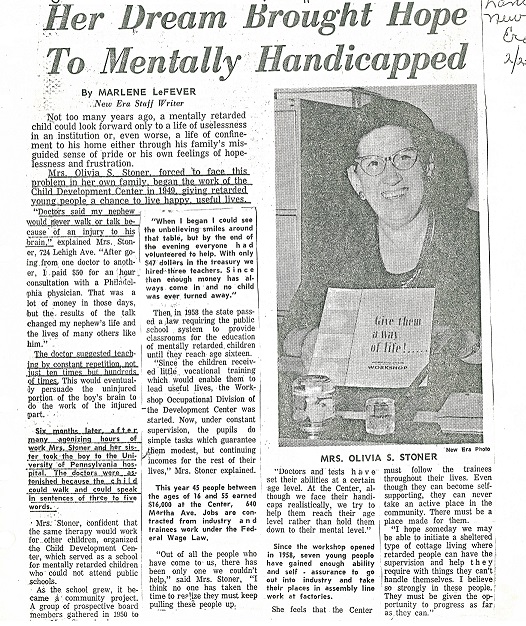
Recently we wrote about our rich history, particularly in relation to the two women who first had the idea for our organization back in 1948. In short, Marian Headrick and Olivia Stoner KNEW in their hearts that the status quo could be, and must be, changed.

Despite being told that the children in their lives were “un-educable” and “feeble-minded,” these women knew that individuals with developmental disabilities were capable of so much more. At the time, the only two options given to the parents of these children were to keep them at home and do nothing, or send them away to live at an institution.

This week, our staff sat down and we viewed “I Go Home,”very powerful documentary about the system of institutions where many believed that individuals like our participants should live. Doctors told family members it was the best thing they could do, as these individuals “had no future” and would “never be productive members of society.” Pennhurst, just a little over an hour away, was one such institution.

Think about it: at the very same time that the Occupational Development Center, and its predecessor, the Child Development Center, were helping individuals with developmental disabilities grow and learn how to earn a paycheck, other individuals like ours were being deemed worthless, and perhaps dangerous, and therefore were institutionalized. In fact, this was still happening at Pennhurst well into the mid-1980’s, and continues to happen, to a lesser degree, at other institutions today.

This is a hard watch, but take an hour and learn more about the way many with developmental disabilities have been treated over the years.

This is why we exist.

We exist to prove that the disabilities of our participants don’t matter.

What does matter is that they are loved and are capable of so much more. What matters is that they are given opportunities to develop their skills and passions, and can become productive members of our community.

We’ve got 70 years in the rear view mirror. We hope you’ll join us for all the exciting things that lie ahead.

70 Acts of Service for Our 70th Anniversary #1

As we celebrate our 70th anniversary, we’ve made the decision to spend part of our year engaging in something we are calling “70 Acts of Service.”

Throughout the year, our participants will be volunteering in various capacities and giving something back to the community that has given us so much since our humble beginnings back in 1948.

Our first act of service for this year is actually something we do every week. Every Thursday we send a crew out to the Power Packs Project, one of the many great nonprofits in our area. Our participants loaded up a truck with food and then deliver it to Carter & MacRea Elementary School for distribution to the families of kids in the school lunch program. By doing this, not only are we serving our community, but our participants are learning valuable vocational skills, along with the importance of community work.

Here are some photos of Gary, Maria, and Michael helping out:


This is just one way that we and our participants are giving back to our community.

And, this is just the first of AT LEAST 70 Acts of Service we’ll be doing throughout the year.

If you have ideas for us on ways we can serve area organizations, businesses, or individuals, email us with your ideas, and we’ll consider adding it to our list. We’re always on the lookout for more opportunities!

70 Years of Creating Opportunity Through Community

70 years.

That’s how old we are this year.

When the idea that became the Occupational Development Center was in its formative stages, Harry S. Truman was President, the average American earned less than $3,000 a year, and a gallon of gasoline cost just 16-cents. The United States had just emerged from World War II a few years earlier, and as a result of the war, the role of women in our society had changed radically.

Why is this important? Because it was the determination of two women that made it possible for us to be here today.

Back in 1948 Marian Headrick and Olivia Stoner put their heads together and determined that something positive needed to be done for some of their family members. Mrs. Headrick’s son, James, and Mrs. Stoner’s nephew, Harold Rutter, were both young boys diagnosed with intellectual/developmental disabilities, or at the time, what was commonly known as “mental retardation.”

At the time, the fate of most kids with a diagnosis of I/DD was either to stay at home with family or be institutionalized. School was not an option as those individuals were deemed “uneducable.” Special education for these kids wouldn’t be mandated in Pennsylvania until about ten years later.

But Mrs. Headrick and Mrs. Stoner weren’t having any of this. They knew that these young men weren’t “feeble” and COULD learn!

Mrs. Stoner summed it up well in 1965:

“Doctor’s said my nephew would never walk or talk because of an injury to his brain. After going from one doctor to another, I paid $50 for an hour consultation with a Philadelphia physician. That was a lot of money in those days. , but the results of the talk changed my nephew’s life and the lives of many others like him.”

The doctor suggested teaching by constant repetition, not just ten times, but hundreds of times. This would eventually persuade the uninjured portion of the boy’s brain to do the work of the injured part.

Six months later, after many agonizing hours of work, Mrs. Stoner and her sister took the boy to the University of Pennsylvania hospital. The doctors were astonished because the child could walk and could speak in sentences of three to five words.

Lancaster New Era, February 25, 1965
So seventy years ago, back in 1948, these two women came up with the idea for what is now the ODC. It was, at first, a special education school for kids with I/DD, and over the years has evolved into what we offer now, with vocational and skill training, and employment services, for adults with I/DD. And these services are invaluable to the businesses and organizations with whom we work.

We are grateful for these two women, their determination, their vision, and their belief that the individuals who come to the ODC are capable of amazing things!

2018 marks our 70th anniversary and we’ll be telling our story all year long, as well as planning some special events and opportunities.

Join us as we journey forward toward what we hope are many more years of celebrating the successes of our participants!
Christmas with the ODC

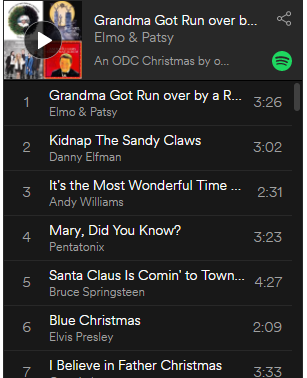
‘Tis the season, so we asked our staff and participants to let us know about their favorite holiday songs. Here’s the list we compiled (so far), so hit Play and enjoy Christmas with the ODC!